
Quantum Correlated Light – Routinely used in Gravitational Wave Detectors
Zeit
Ort
Anna-von-Helmholtz-Bau
Eingang: Ecke Marchstraße/Fraunhoferstraße
Organisation
Sprecher:innen
- Prof. Dr. Roman Schnabel
Im Berliner Physikalischen Kolloquium wird
Prof. Dr. Roman Schnabel,
Universität Hamburg,
vortragen.
Zusammenfassung
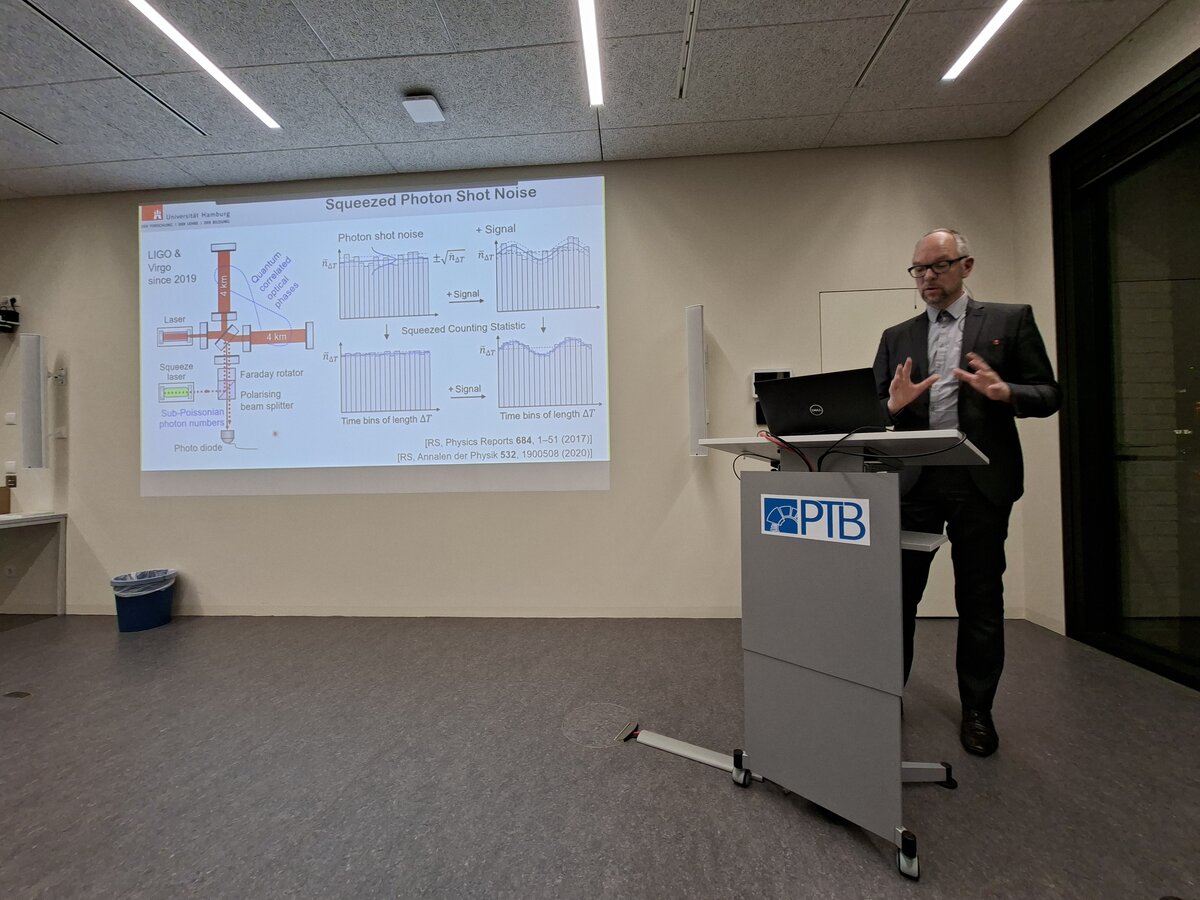
Light with squeezed quantum uncertainty allows for the sensitivity improvement of laser interferometers. In 2011, the GEO600 gravitational wave detector used squeezed light in its joint search for gravitational waves with Virgo [1,2]. The successful sensitivity improvement triggered the implementation of squeezed light sources also in Advanced LIGO and Advanced Virgo. On April 1st, 2019 these observatories started their third observational run. Since then, they have been detecting more than one GW event per week. An increased event rate of up to 50% is due to the exploitation of squeezed states of light [3–5]. Squeezed light is fully described by quantum theory, however, observations on squeezed light represent physics that is not self-evident. I present a description of why a squeezed photon counting statistic is rather remarkable.
[1] LIGO Scientific Collaboration, Nature Physics 7, 962 (2011).
[2] H. Grote et al., Phys. Rev. Lett. 110, 181101 (2013).
[3] M. Tse et al., Phys. Rev. Lett. 123, 231107 (2019).
[4] F. Acernese et al., Phys. Rev. Lett. 123, 231108 (2019).
[5] R. Abbott et al., Phys. Rev. X 11, 021053 (2021).